Showing posts with label Papyrus. Show all posts

Saturday, 12 April 2014

Fresh Water Exhibition- Agua Doce


It rained in Galicia, not a heavy rain, but a gentle persistent mist that softened the ancient silhouette of 
Santiago de Compostela.
 I had travelled with my parents to Galicia, to visit the Fresh Water Exhibition in the magnificent Gaiás Centre MuseumHowever not even the weather could dampen our spirits, because we had come to see my painting of  papyrus hanging in the museum


“With the works by geniuses such as  John ConstableDavid HockneyGerhard RichterLouise BourgeoisMario MerzMartín Chirino and Chema Madoz as well as important Galician creators, this exhibition proposes an intense aesthetic experience through a multidisciplinary selection of artworks including painting, sculpture, photography, video, installation, scientific devices and ethnographic pieces.”

A huge sculpture made of books representing a vortex of ideas and words
The exhibition was opened by Crown Prince Felipe on March 21st, on the eve of World Water Day, and has already had more than 7000 visitors in the first two weeks. The museum is vast, over 6600m2 of exhibition space, spread across four floors, but everything has been very cleverly laid out. A series of temporary walls, painted in rich dark colours, invite you to weave your way through, with surprises around every corner to intrigue and inspire you.

All life begins with water and water is essential for all life.
The journey begins.

“Water is the driving force of all nature.” Leonardo da Vinci

Of course, I was eager to see the botanical paintings, so we hurried to the first floor “Water on Earth”. This floor is dedicated to telling the story of the great rivers of the world, and how water has shaped the landscape. There is an incredibly impressive gallery with paintings by the likes of Gerhard Richter, John Constable, Anton Mauve, Graham Sutherland and  Henry Lewis, to name but a few. 

Finally we turned a corner, and there they were!! The SBA paintings. 


"Art and science, aesthetic impact and cool analysis are combined in the ornithological drawings of Audobon, who traversed the forests of North America in pursuit of the beauty of birds. ... A further example of the descriptive efforts of nineteenth century biologists is furnished by the botanical plates produced by Kew Gardens. This tradition lives on thanks to the work of members of the Society of Botanical Artists." (Exhibition catalogue)

L-R Sue HénonRobert McNeillShevaun DohertyMariko Aikawa 
Flying the flag for the SBA were Penny BrownSue HénonRobert McNeillMariko Aikawa ......and me! I felt quite humbled to find my work hanging beside such wonderful artists, but very, very proud.  Marta Chirino SBA also had three stunning botanical illustrations in the exhibition. 
Marta Chirino Argenta SBA
On an adjacent wall were the paintings from Kew Gardens. The artists were Fanny Russell, Joan Bacon, Margaret Stones and Sydenham Edwards.


 I especially liked the mixed compositions of Joan Bacon. I was charmed to later read that she won a medal  for her work at age 92!
Utagawa Hiroshige, Nishki-e (1833-34)
The paintings were all in good company because on the opposite wall, were a series of engravings by Hokusai and Hiroshige. What a treat!


Huge prints from another favourite, the master of ornithology, James John Audobon

This exhibition absorbs you, delights you and fascinates you. We saw paintings and sculptures from the Inuits, the Aboriginals, the Amazon river and of course the Nile. 

A gorgeous little travel sketch painted Egypt by Edward Lear, (author of The Owl and The Pussycat)

Butterflies from the Amazon River
The exhibition also explored  Hidden Water, Humankind's relationship with water, and finished with Gazing at the Sky. There was something for everyone, from Roman mosaics to modern-day spas, Egyptian amulets,engineering and scientific equipment, glassware (amazing stuff by Lalique) , satellite images, book illustrations (The Hobbit, Alice in Wonderland), sheet music (Johann Strauss's Blue Danube), photography, video installations, costumes, sculpture and much, much more.  Despite the diversity of objects everything had the common theme of fresh water.

David Hockney's Lithographs of The Weather Series. I especially like the middle one, The Rain. You can see a better image here

I loved this enormous painting by Spanish painter José Freixanes (2001) 200x200cm
The highlight of the whole trip was meeting the Director of the museum, María Periera, who came to meet me and talk to me about my work. It was such an honour to realise that my little painting is hanging alongside works from great cultural institutions like the MoMA, the Victoria & Albert, the Musée D’Orsay, the Rijksmuseum, the Reina Sofía and the Thyssen-Bornemisza. 

She presented me with a beautiful book of the exhibition that I will always treasure.

One happy artist with Director Maria Pereira!
The exhibition runs from March 21st until September 14 2014. If you are walking the Camino, or just visiting Galicia, it's definitely worth a visit.

Friday, 7 March 2014

Papyrus


I am bursting with excitement this week!
I have just sent my papyrus painting off to the Gaiás Centre Museum in Galicia, Spain, where it will be taking part in an exhibition on Fresh Water, running from March until September 2014. It is an ambitious project which aims to cover all aspects of water, and man’s relationship with it.

https://www.cidadedacultura.org/gl/evento/auga-doce
This is translated from the exhibition description (yet to go out in English)-
“Paintings, sculptures, photography, video and installation go hand in hand of scientific devices, technological advances or ethnographic objects. A total of 700 works that immerse visitors in an intense aesthetic experience through great names of contemporary art such as David Hockney, Gerhard Richter, Mario Merz, Louise Bourgoise, Martín Chirino or Chema Madoz and teachers of classics from the likes of Piranesi, John Constable, Henry Lewis or Audubon”

That’s an impressive list of artists!!  I am so honoured that my painting will be in such good company!
My painting will help explain the story of the Cyperus papyrus plant, and how this humble aquatic plant transformed the lives of the ancient Egyptians and helped shape the world we live in today.  

Over 5000 years ago the ancient Egyptians developed a way of turning this elegant sedge into a durable, lightweight sheet for writing on. With this discovery came the ability to communicate, share knowledge and ultimately write history. It was such an important plant that it became a symbol of ancient Egypt, along with the lotus flower. They didn’t just use it for writing though. They used the papyrus for boat building, basket weaving, food, medicine, perfume and fuel. The ancient Egyptians referred to it as “pa-per-aa”  which means “That which is of the Pharaoh”, and the manufacture of papyrus paper was kept a closely guarded secret.

wall carving in Edfu temple of papyrus and lotus buds, the symbols of Lower and Upper Egypt,

However in 105 AD, a Chinese court official Ts'ai Lun invented paper, and within a few centuries paper and vellum began to replace the papyrus paper. By the 10th century, papyrus cultivation had all but disappeared in Egypt, and with it went the secrets of the Pharaohs.
Over the centuries, people tried to make papyrus sheets but to no avail. It seemed that this art form was lost to the world. It wasn’t until 1962 when an Egyptian engineer, Dr Hassan Ragab managed to figure out the methods used. He travelled to Sudan and Ethiopia to bring papyrus plants back to Egypt, and planted a papyrus plantation on an island on the Nile. He also reintroduced plants that had once thrived in ancient Egypt.
To see how papyrus is made, watch this slideshow-  http://www.lib.umich.edu/papyrus_making/lg_intro.html

By the time that I travelled down the Nile, papyrus paper was once more readily available. I was fascinated to see the process and couldn’t resist buying a few blank sheets.


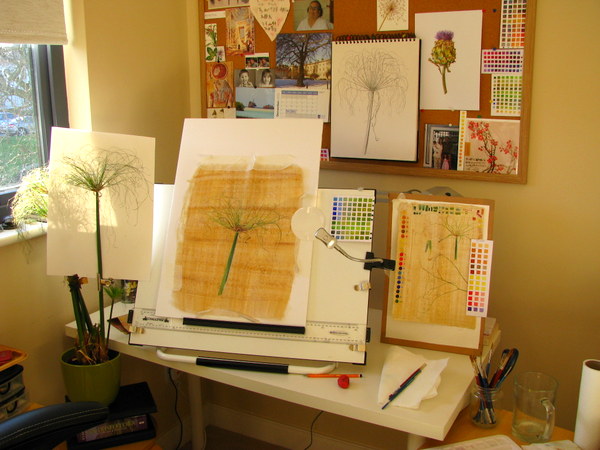
When I returned to Dublin, I was surprised to find a dwarf papyrus plant, Cyperus prolifer Lam in a local nursery. It was serendipity, I thought, for what subject could be better suited for papyrus paper? I experimented on the papyrus and eventually decided to paint in gouache, a first for me! Luckily my friend Claire Ward was on hand to give me advice about this medium. She has great gouache demos on her website http://drawntopaintnature.blogspot.ie/2011/09/gouache-technique.html


I did a graphite sketch of the plant and liked how the feathery stems of the umbel were almost calligraphic in nature. Painting a papyrus plant on papyrus paper was quite exciting because the paper has a lot of texture, and I tried to incorporate some of the fibres into the painting. It really is a beautiful plant, feathery and elegant.

Cyperus prolifer Lam on papyrus paper, gouache , Shevaun Doherty 2012

Next month I will travel to Santiago de Compostela to visit the exhibition. I’ll be the one grinning like a Cheshire cat no doubt! 


Saturday, 30 November 2013

Egypt and Botanical Beginnings


There’s an old Egyptian saying, “Once you drink from the Nile, you are destined to return”.
However I knew from the moment I stepped out into Cairo’s warm night air, heavy with the sweet scent of jasmine, twenty five years ago, that Egypt would always be a part of my life.

Keystone over the main door of the Egyptian Museum, Cairo
Whilst living in Egypt, there was nothing that I loved more than to go off and explore the Egyptian countryside, always bringing my sketchbook and my camera . Once you escape the hustle and bustle of Cairo, it’s so easy to imagine that you have stepped back in time- cattle grazing in marshy pastures along the Nile, long-robed men working in the fields, children scampering down to the river’s edge to play and splash in the cool waters, tall palm trees standing silhouetted against a balmy sky.  It was scenes like this that inspired me to learn how to paint in watercolour.

Saqqara afternoon

Blue cabbages and egrets

Wherever I went, I was made feel most welcome, and would often look up from my sketchbook to find myself completely surrounded by curious children, or strangers bringing me hot mint tea or a cushion from their home to sit on as I sketched.
Crossing the Nile 
It was in Egypt too that I first started to learn about botanical art, inspired by all the beautiful flora and fauna that I saw.  How appropriate it was to discover that Egypt was also the birthplace of botanical art!

A lot of what we know about ancient Egypt comes from the art painted on the walls of temples, tombs and papyri. To the ancient Egyptians, art was not just a decorative feature, it also contained powerful magic.  The images that they created  reflected their love of order and the triumph of man over nature. Accurate representations were important because all of the people, plants and animals portrayed would continue to live on in the afterlife. They used clean lines, simplified forms, areas of flat colour, and a balanced composition to create their images. They were not interested in light and shadow as these were transitory features. Every image and colour had a symbolic meaning and purpose. Pigments were mainly mineral and mixed with mediums such as gum Arabic (resin from the acacia tree), wax and casein.

“Nature is the best and the shortest route towards knowledge”
 Inscribed on the wall of a temple in Luxor

The ancient Egyptians studied the flora and fauna carefully, believing them to hold all the secrets of life. Their culture was very closely bound to the natural world. The blue lotus, Nymphaea caerulea, was considered the most sacred of all plants. The flowers emerge from the water each morning at dawn, just as the sun is being rolled into the sky by Kheper, the sacred scarab beetle, and so the flowers were considered living proof of rebirth. Their intense fragrance was an indicator of a divine presence. The white lotus, Nymphaea lotus, was also sacred, as was the papyrus plant, Cyperus papyrus, which grew in dense thickets along the banks of the Nile, harbouring an abundance of wildlife. It symbolised fertility and also protection, and was one of the most useful and important plants for the ancient Egyptians.
Nymphaea caerulea in the Temple of Flora, Robert Thornton

Nymphaea lotus, L. van Houtte, www.plantillustrations.org
It was said that the ancient Egyptians celebrate a Feast of Lotus, where they placed candles in small silver lotus-shaped pots. Each person would go down to the Nile with the pot in his hand and an overwhelming dream in his heart. The pots were placed upon the water with the burning candles. If they remained floating, then their heart’s desires would come true.
The ancient Egyptians loved their gardens, which they filled with a large variety of trees, vegetables and flowers. Usually at the centre of each garden there was a pool of water filled with lotus and papyrus plants. As well as places of sanctuary and cool shade, gardens had religious importance and many  deities were associated with the plants grown within. 

A garden fresco from the tomb of  Nebamun, British Museum showing sycamore figs, date palms, doum palms, persea trees, mandrakes and a pond full of lotus plants, fish and geese
 The most famous of all gardens was probably that of Hatshepsut(1508–1458 BC), one of Egypt’s first female pharaohs and certainly one of the most successful, ruling for over twenty years. One of her great achievements was her trade expedition to the fabled land of Punt (thought to be Somalia), where they collected trees of myrrh and frankincense, the resin of which was vital in the ritual of embalming. The trees were transported back in baskets with their roots intact, and planted around her magnificent mortuary temple, Deir al Bahri, their transportation forever recorded on the walls of her temple.

An inscription of the walls of Hatshepsut’s temple states that "the ships were laden with the costly products of the Land of Punt and with its many valuable woods, with very much sweet-smelling resin and frankincense, with quantities of ebony and ivory . . ."
However it was her young nephew and co-regent Thutmosis III, who was the creator of the first botanical art. Whilst his aunt remained in Egypt, he travelled extensively, expanding their empire until it stretched from Sudan to Syria. When he returned, he decided to build a great Festival temple at Karnak, something that would reflect his greatness as God-King. He filled his Festival Temple with gold and precious stones, and at it’s heart built a secret sanctuary, known as The Botanical Chamber which was decorated with wonderful painted carvings of more than 300 specimens of flora and fauna. An inscription reads that the chambers contained
“…all the plants that grow, all the flowers that are in God’s hand …“

Although the temple lies in ruins now, it is still possible to identify many of plants and animals depicted- Dracunculus vulgaris (Dragon Arum),  Kalanchoe aegyptiaca, chrysanthemum, Arum italicum,  Dipsacus (teasel) , Iris flowers , Punica granatum (pomegranates), Vitis vinifera (grapevines), a female gazelle, a goose, a lapwing, a plover, a white egret, a migrating grasshopper and many more.
Fortunately, the Botanical Chamber has been very cleverly reconstructed in a video and we can get an idea of how this great work of art must have looked three and a half thousand years ago. It is in arabic but subtitled, well worth viewing!


Egypt has a special place in my heart, and as they say, I have drunk the waters so I will return.

“Egypt is a great place for contrasts: splendid things gleam in the dust.”
Gustav Flaubert, Flaubert in Egypt: A Sensibility on Tour

A sketch from the tomb of Thutmosis III