Showing posts with label gouache. Show all posts

Saturday, 19 April 2014

The Barn Owl

 
Barn Owl, Tyto alba, Shevaun Doherty 2013

My very first framed painting was of a Barn Owl, Tyto alba which to this day still hangs on the wall in my parent’s home. I was seven at the time, but it’s interesting to realise that even at an early age, I loved both art and nature.


My first ever painting, aged seven!
The reason that I mention this now is because I’m working on another barn owl painting at the moment. Despite a gap of almost forty years, I even stuck to the same composition. I actually started this painting a year ago, a gift for my brother, but it was put aside as I needed to concentrate on my botanical work. 
It’s now time to finish it.

A quick study of a barn owl done at the Natural History Museum
Drawing from life gives an invaluable insight into understanding your subject, so the first step was to head into the Dublin’s Natural History Museum, with a sketchbook, waterbrush and paints. I was pleasantly surprised by how helpful the staff were- they led me to the display of barn owls and even brought a comfortable chair for me to sit on. Bliss! I know that some people feel intimidated by sketching in public, but I generally find that people keep a very respectful distance, and you soon become so absorbed in the subject that you don’t even notice the watchers. Listening to music with earphones helps too.


I decided to paint the owl in gouache and watercolour on blue-grey card, which I felt would help show off the beautiful patterns on the feathers. Those feather patterns are challenging! I had to practice first on a small piece of card. It’s a bit like figuring out what pieces of a puzzle go where. 

Colour chart of both gouache and watercolour on toned card. The watercolours are marked wc. This has proven to be an invaluable help, particularly as gouache darkens as it dries

Using photographs and sketches as reference, I drew out my owl using a white watersoluble pencil. It blends into the subsequent paint layers and any lines that are left can be easily rubbed out. Gouache is so forgiving and can be combined quite nicely with watercolours. As my friend Claire said, it’s a case of “Forward and back, slowly building up the layers.”
Work was progressing quite nicely, but I ran into trouble with the feet. I didn’t study them properly in the museum, and wasn’t happy with the photographs. I also ran out of time, and so the painting was set aside.

This week I picked up where I left off. I decided to add some dried grasses that I had collected last summer. What fascinating little subjects! I found myself becoming totally engrossed with them and probably spending far too much time on them. 


I laid the grasses directly onto the card to decide their position and also to paint.


I had planned to go back into the Museum to do a study of the feet, but this week weather has been lovely, and I’ve enjoyed catching up with some good friends instead. I love painting but sometimes you need a bit of sunshine and good company to get balance in your life. The owl, ever patient, can wait.

Nearly there!


Friday, 7 March 2014

Papyrus


I am bursting with excitement this week!
I have just sent my papyrus painting off to the Gaiás Centre Museum in Galicia, Spain, where it will be taking part in an exhibition on Fresh Water, running from March until September 2014. It is an ambitious project which aims to cover all aspects of water, and man’s relationship with it.

https://www.cidadedacultura.org/gl/evento/auga-doce
This is translated from the exhibition description (yet to go out in English)-
“Paintings, sculptures, photography, video and installation go hand in hand of scientific devices, technological advances or ethnographic objects. A total of 700 works that immerse visitors in an intense aesthetic experience through great names of contemporary art such as David Hockney, Gerhard Richter, Mario Merz, Louise Bourgoise, Martín Chirino or Chema Madoz and teachers of classics from the likes of Piranesi, John Constable, Henry Lewis or Audubon”

That’s an impressive list of artists!!  I am so honoured that my painting will be in such good company!
My painting will help explain the story of the Cyperus papyrus plant, and how this humble aquatic plant transformed the lives of the ancient Egyptians and helped shape the world we live in today.  

Over 5000 years ago the ancient Egyptians developed a way of turning this elegant sedge into a durable, lightweight sheet for writing on. With this discovery came the ability to communicate, share knowledge and ultimately write history. It was such an important plant that it became a symbol of ancient Egypt, along with the lotus flower. They didn’t just use it for writing though. They used the papyrus for boat building, basket weaving, food, medicine, perfume and fuel. The ancient Egyptians referred to it as “pa-per-aa”  which means “That which is of the Pharaoh”, and the manufacture of papyrus paper was kept a closely guarded secret.

wall carving in Edfu temple of papyrus and lotus buds, the symbols of Lower and Upper Egypt,

However in 105 AD, a Chinese court official Ts'ai Lun invented paper, and within a few centuries paper and vellum began to replace the papyrus paper. By the 10th century, papyrus cultivation had all but disappeared in Egypt, and with it went the secrets of the Pharaohs.
Over the centuries, people tried to make papyrus sheets but to no avail. It seemed that this art form was lost to the world. It wasn’t until 1962 when an Egyptian engineer, Dr Hassan Ragab managed to figure out the methods used. He travelled to Sudan and Ethiopia to bring papyrus plants back to Egypt, and planted a papyrus plantation on an island on the Nile. He also reintroduced plants that had once thrived in ancient Egypt.
To see how papyrus is made, watch this slideshow-  http://www.lib.umich.edu/papyrus_making/lg_intro.html

By the time that I travelled down the Nile, papyrus paper was once more readily available. I was fascinated to see the process and couldn’t resist buying a few blank sheets.


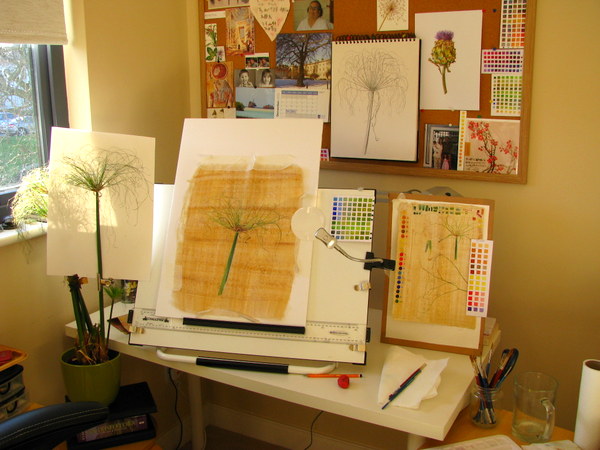
When I returned to Dublin, I was surprised to find a dwarf papyrus plant, Cyperus prolifer Lam in a local nursery. It was serendipity, I thought, for what subject could be better suited for papyrus paper? I experimented on the papyrus and eventually decided to paint in gouache, a first for me! Luckily my friend Claire Ward was on hand to give me advice about this medium. She has great gouache demos on her website http://drawntopaintnature.blogspot.ie/2011/09/gouache-technique.html


I did a graphite sketch of the plant and liked how the feathery stems of the umbel were almost calligraphic in nature. Painting a papyrus plant on papyrus paper was quite exciting because the paper has a lot of texture, and I tried to incorporate some of the fibres into the painting. It really is a beautiful plant, feathery and elegant.

Cyperus prolifer Lam on papyrus paper, gouache , Shevaun Doherty 2012

Next month I will travel to Santiago de Compostela to visit the exhibition. I’ll be the one grinning like a Cheshire cat no doubt!