
I am bursting with excitement this week!
I have just sent my
papyrus painting off to the Gaiás Centre Museum in Galicia, Spain, where it
will be taking part in an exhibition on Fresh Water, running from March until September 2014. It is an ambitious project which aims to cover all aspects of
water, and man’s relationship with it.
 |
| https://www.cidadedacultura.org/gl/evento/auga-doce |
This is translated from the exhibition description (yet to go out in English)-
“Paintings, sculptures, photography, video and installation
go hand in hand of scientific devices, technological advances or ethnographic
objects. A total of 700 works that immerse visitors in an intense aesthetic
experience through great names of contemporary art such as David Hockney, Gerhard
Richter, Mario Merz, Louise Bourgoise, Martín Chirino or Chema Madoz and
teachers of classics from the likes of Piranesi, John Constable, Henry Lewis or
Audubon”
That’s an impressive list of artists!! I am so honoured that my painting will be in such
good company!
My painting will help explain the story of the Cyperus papyrus plant, and how this
humble aquatic plant transformed the lives of the ancient Egyptians and helped
shape the world we live in today.
Over 5000
years ago the ancient Egyptians developed a way of turning this elegant sedge
into a durable, lightweight sheet for writing on. With this discovery came the
ability to communicate, share knowledge and ultimately write history. It was such
an important plant that it became a symbol of ancient Egypt, along with the
lotus flower. They didn’t just use it for writing though. They used the papyrus
for boat building, basket weaving, food, medicine, perfume and fuel. The
ancient Egyptians referred to it as “pa-per-aa”
which means “That which is of the Pharaoh”, and the manufacture of
papyrus paper was kept a closely guarded secret.
 |
| wall carving in Edfu temple of papyrus and lotus buds, the symbols of Lower and Upper Egypt, |
However in 105 AD, a Chinese court official Ts'ai Lun
invented paper, and within a few centuries paper and vellum began to replace
the papyrus paper. By the 10th century, papyrus cultivation had all
but disappeared in Egypt, and with it went the secrets of the Pharaohs.
Over the centuries, people tried to make papyrus sheets but
to no avail. It seemed that this art form was lost to the world. It wasn’t
until 1962 when an Egyptian engineer, Dr Hassan Ragab managed to figure out the
methods used. He travelled to Sudan and Ethiopia to bring papyrus plants back
to Egypt, and planted a papyrus plantation on an island on the Nile. He also
reintroduced plants that had once thrived in ancient Egypt.
To see how papyrus is made, watch this slideshow- http://www.lib.umich.edu/papyrus_making/lg_intro.html
To see how papyrus is made, watch this slideshow- http://www.lib.umich.edu/papyrus_making/lg_intro.html
By the time that I travelled down the Nile, papyrus paper
was once more readily available. I was fascinated to see the process and
couldn’t resist buying a few blank sheets.
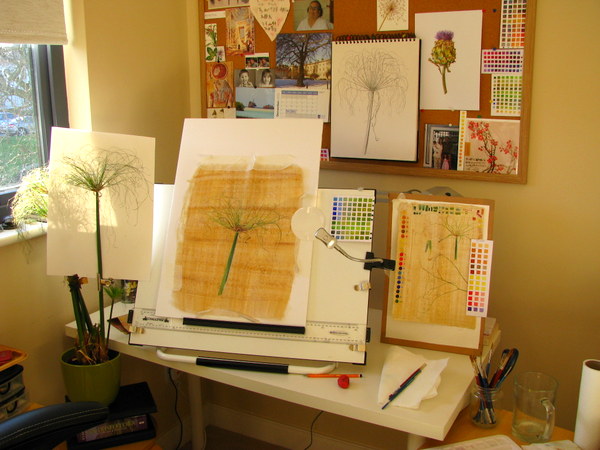
When I returned to Dublin, I was surprised to find a dwarf papyrus plant, Cyperus prolifer Lam in a local nursery. It was serendipity, I thought, for what subject could
be better suited for papyrus paper? I experimented on the papyrus and
eventually decided to paint in gouache, a first for me! Luckily my friend Claire Ward was on hand to give me advice about this medium. She has great gouache demos on her website http://drawntopaintnature.blogspot.ie/2011/09/gouache-technique.html

I did a graphite sketch of the plant and liked how the
feathery stems of the umbel were almost calligraphic in nature. Painting a
papyrus plant on papyrus paper was quite exciting because the paper has a lot
of texture, and I tried to incorporate some of the fibres into the painting. It
really is a beautiful plant, feathery and elegant.
 |
| Cyperus prolifer Lam on papyrus paper, gouache , Shevaun Doherty 2012 |
Next month I will travel to Santiago de Compostela to visit
the exhibition. I’ll be the one grinning like a Cheshire cat no doubt!


