Showing posts with label Conkers. Show all posts

Monday, 9 February 2015

Conkered

Per aspera ad astra-
Through difficulties to the stars

There has been a battle in my studio this week. Whilst my paperwork mountain was slowly being tackled, a little conker  sat on my desk, patiently awaiting my attention.
 I love painting conkers(Aesculus hippocastanum). I don’t know whether it’s the rich earthy colours or that tactile smoothness, but they make the perfect subject.

My page of conkers has now been stuck into Dianne's sketchbook for the Nature Trails Sketchbook Exchange
 I have painted them quite a few times now, but always on paper, never on vellum. I did try once, but gave up in exasperation. To get that rich patina you need quite a few layers of paint, and that can be a challenge on vellum. Suddenly you can find that you’re lifting paint off instead of adding another layer, and the more that you try to fix it, the quicker it turns into a blobby, patchy mess.
However, undeterred by the last disaster, I began.


I was feeling confident. I threw on a few initial washes of colour.
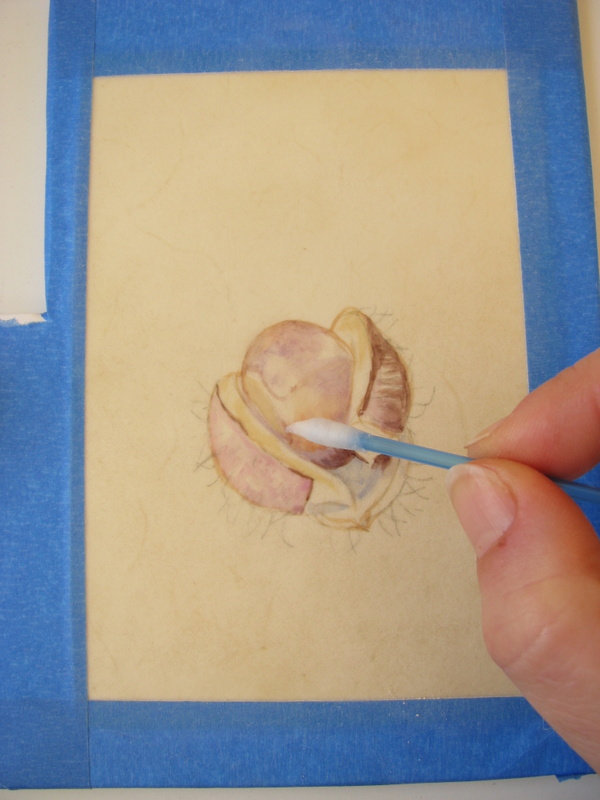
It wasn’t long before I was trying to fix things using a dampened cotton bud. Because the paint sits on the surface of the vellum, it's easy to wipe off. Perhaps a little too easy.

 However as I progressed, it became apparent that I had not put in enough blue in my initial washes, essential for that convincing gleam. I began to fuss, and it quickly became a horrible mess. I tried to scrape some of it off, but this is natural calf vellum, not kelmscott, which has a chalky coating, and so I ended up scuffing up the surface. The paint got caught in it and stained, leaving a dark and horrible patch. I wiped as much as I could off.

Attempt #2- I have to disguise that horrible dark patch
I decided to start again, but moved the conker up on the vellum to cover the recriminating patch. This time, I decided to start on the polished conker, ignoring the prickly cases.


Sometimes starting again can be the best option. You are aware of the mistakes that you have made and so take care to avoid them.


The colours that I used this time were similar to the ones that I used before, but with a few changes. I used Indanthrene instead of Cobalt and avoided Indigo altogether. For my really dark darks, I used Perylene violet with a little Perylene green. I also used a tiny bit of Transparent Brown Oxide and Burnt Bronzite from my Daniel Smith dot charts for the shell.


I ran out of daylight hours in my haste to finish this, so the photograph of the finished piece is not the best. I’m quite pleased with how it turned out though and glad that I persisted.


Today I was given some glorious lilies, exuberant beauties that are just begging to have their portrait painted. My palette will be washed, the earth colours put away and those delicious purple pigments will be coming out to play! Even the paperwork pile is looking less daunting.

That which we persist in doing becomes easier - not that the nature of the task has changed, but our ability to do has increased.” 
Ralph Waldo Emerson

Sunday, 30 November 2014

Play!

“A little nonsense now and then, is cherished by the wisest men.”
~Roald Dahl (Charlie and the Great Glass Elevator)


It’s good to play. Sometimes we get so caught up in life, in the frantic rush to get things done, that we often forget to take a little time out to just enjoy a bit of creative fun.
So with that in mind, I decided to make this week all about play.

Conker set-up- the little bit of silver paper bounces light back up onto the conker and the colour chart helps me select my colours.

 I started with a little thank you gift for a friend. I enjoy painting conkers as they don’t take long to do, and yet they always evoke an emotional response from people. I recently broke a few botanical art rules by naming my conkers in the Law Library exhibition, but sometimes a little bit of humour goes a long way. I was amazed at how many people asked me for “Well Hung”.

As for this one, well, it’s Veni, Vidi, Vici (I came, I saw, I conquered).
Every time I hear about a new product or medium, my ears prick up. I have an insatiable curiosity to try them all out. Needless to say, my art cupboard is full of things that I have bought on an impulse, or rescued and kept. Two of the products that I have wanted to try out are Yupo and the Ampersand aquabords.

Friday, 3 October 2014

Alexander & Conkers


“Just to paint is great fun. The colours are lovely to look at and delicious to squeeze out. Matching them, however crudely, with what you see is fascinating and absolutely absorbing.”
Winston Churchill

I was completely taken by surprise when a beautifully wrapped parcel arrived last week from the States. 
Amongst the trove of treasures that lay within, was a curious little box with the words Alexander carefully written on the lid. Any other person might have first looked at the accompanying card, but caught up in the excitement of these unexpected gifts, I ripped open the little box …  and shrieked like a banshee when an enormous and very dead beetle fell out! 
A kind hearted friend, knowing my fondness for beetles, had found him and decided to post him to me. She called him Alexander after this lovely poem by A.A. Milne

Alexander is a ten lined June beetle, or watermelon beetle, a native of the USA. When I read up about these beetles, I discovered that the males have enormous antennae which they use to sniff out the females. Sadly, by the time that Alexander had made his transAtlantic crossing, he was missing both his antennae and the bulk of his legs, but with a bit of creative licence, I managed to restore him to his former glory and painted him at twice his actual size. His portrait will be winging it's way back to my thoughtful friend this week  (thank you DM). As another friend remarked “He’s the dandy of the Beetle World”.


I found a little beetle, so that Beetle was his name,
And I called him Alexander and he answered just the same.
I put him in a match-box, and I kept him all the day ...
And Nanny let my beetle out -
Yes, Nanny let my beetle out -
She went and let my beetle out -
And Beetle ran away. 
 

 Conkers


Feeling very pleased with myself, I decided to paint a few conkers. For those who don't know, conkers are the common name for the fruit of the Horse Chestnut tree, Aesculus hippocastanum 

Colour chart of earth pigments- there are quite a few that I don't use, but it's handy to see them all side by side like this.
I have a little colour chart of all the earth colours that I have which I always keep nearby. Although I do like to mix my own browns, it’s really useful to have a small chart like this and I constantly refer to it. It’s also quite startling to see the difference between the different brands of the same pigment, most notably Winsor & Newton’s raw umber and Daniel Smith’s raw umber. I use them both a lot!

Conker progression
The shiny new conkers are a joy to paint. Once I had figured out what colours to use and in what order, they are not too different from painting dates. They take careful observation, lots of layers and dry brushwork. 

As always I started with a base washes of cerulean and cobalt violet, taking care to reserve the highlights. Then I began with the lighter colours, getting progressively darker as more and more layers went on. I blended each layer as I went, and took care to keep the edges paler than the center. 

Cerulean, Cobalt violet, Cobalt (Daniel Smiths),Natural sienna, Winsor orange, Light red, Quinacridone gold deep (Daniel Smiths), Burnt sienna, Burnt Umber, Perylene maroon, Perylene Violet, Purple Lake, Raw Umber and Indigo. I also used Brown madder and Piemontite  (Daniel Smiths) on some of the darker conkers


Another little conker starts off. I've placed the conker on a separate sheet to protect the page, secured with a wad of Blu-Tack to stop it rolling off! You can see the initial washes here.
A few layers of paint later and you have a lovely polished conker

The cases were fun to paint too. I used a wash of Lemon yellow with a touch of sap green (the smallest amount), and then dropped in cerulean and a tiny bit of perylene green where needed. The spikes are the same earthy pigments of the conkers. I definitely needed a magnifying glass to paint those!

The finished page! This will used for my next Nature Sketchbook Exchange entry. 
Using all those transparent pigments has made me yearn for the silky softness of vellum, so conkers on vellum is next on my painting list! Mind you, the rosehips look very tempting too! With so much to choose from, I'm definitely going to be busy!


"Play keeps us vital and alive. It gives us an enthusiasm for life that is irreplaceable. 
Without it, life just doesn't taste good."
 Lucia Capacchione

Friday, 12 September 2014

Autumn Treats

"Every leaf speaks bliss to me, fluttering from the autumn tree." Emily Bronte


Autumn is a visual feast for botanical artists. No season in all the year is as radiantly glorious as the early autumn, particularly when the weather is as pleasant as it has been this week.

“The time of the falling leaves has come again. Once more in our morning walk we tread upon carpets of gold and crimson, of brown and bronze, woven by the winds or the rains out of these delicate textures while we slept.

      How beautifully the leaves grow old! How full of light and color are their last days!” 
  
  John Burroughs (The Falling Leaves)


This week, I’ve been busy with a commission, and whilst painting a non-botanical subject has been a pleasant change, I must confess to feeling a pang of longing every time I step outside. The beautiful russets and golds of fallen leaves lie everywhere, and every hedgerow seems festooned with an abundance of berries and fruit- scarlet, jade, crimson and purple.


Everywhere the delicate green flowers of the ivy beginning to peek out from their glossy  coat of green leaves, attracting a host of nectar-hungry insects.
Conkers (the fruit of the Horse chestnut tree Aesculus hippocastanum) are also starting to fall, some still encased in their spikey green coats, whilst others lie gleaming like polished wood amongst the leaves. I want to pick them up and bring them all home. 

Conker -Fruit of Aesculus hippocastanum
As a child, my brothers and I would forage for hours seeking out the biggest, strongest conkers. The chosen conker was threaded onto a string, and then the conker battles would begin. The idea is to hit your opponent’s conker and smash it. Some people would ‘cure’ their conker by putting it in a warm place to harden, but I must confess to cheating and giving my conkers a secret coat of clear nail varnish.

Ready for battle!
During the First World War, there was a campaign in which everyone (adults and children), were asked to collect horse-chestnuts, and donate them to the government. The conkers were used as a source of starch to produce acetone, which was then used to make the cordite in military armaments. Conkers were chosen because they are rich in starch but not edible, Unfortunately the process was not efficient, and the factory closed after a few months. However, it's easy to imagine the happy respite from the horrors of war that this conker-gathering would have brought to families.
Immature magnolia seedpod

Rosehips
Damson study

This month a number of my botanical art friends are taking place in what has become an annual online event, The 30 day ChallengeEvery day in the month of September, artists from all over the world have been painting small found treasures, and sharing the images online. I've missed the first two weeks of this year’s challenge, but with such an abundance of Autumn treasures, I’m really tempted to join in for the final flurry. You can read more about the challenge (and also how to take part) on my friend Sigrid Frensen’s blog- http://sigridfrensen.blogspot.ie/2014/09/30-day-challenge.html 

Dianne Sutherland Ball's 30 day Challenge painting is a real feast for the eyes.
You can read about the challenge on her blog-  http://diannesutherland.blogspot.ie/2013_09_01_archive.html


"Autumn, the year's last, loveliest smile."
-William Cullen Bryant