Saturday, 12 July 2014

Bloom and Leaves

Take rest; a field that has rested gives a beautiful crop”  Ovid

After my flurry of painting last week, I needed to a few days to unwind, and there’s really no better place to relax and contemplate life, than under the gently swaying fronds of a palm tree.
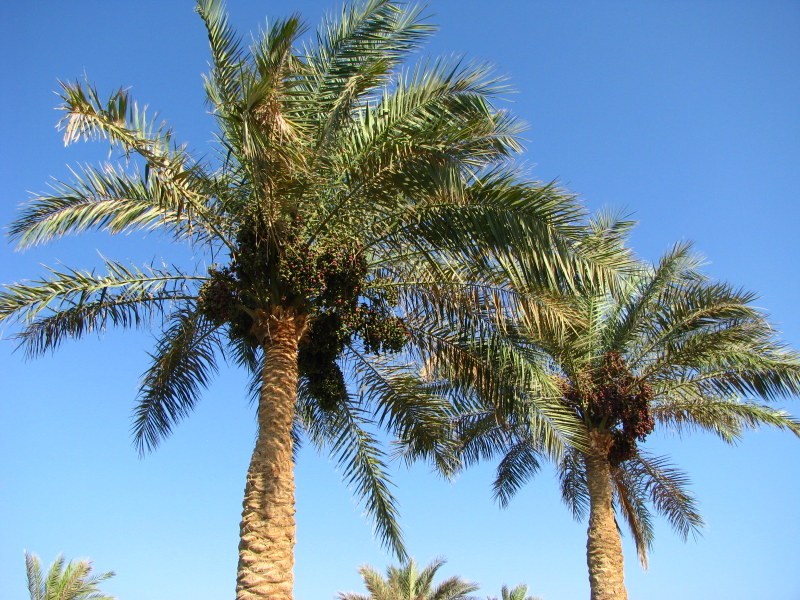

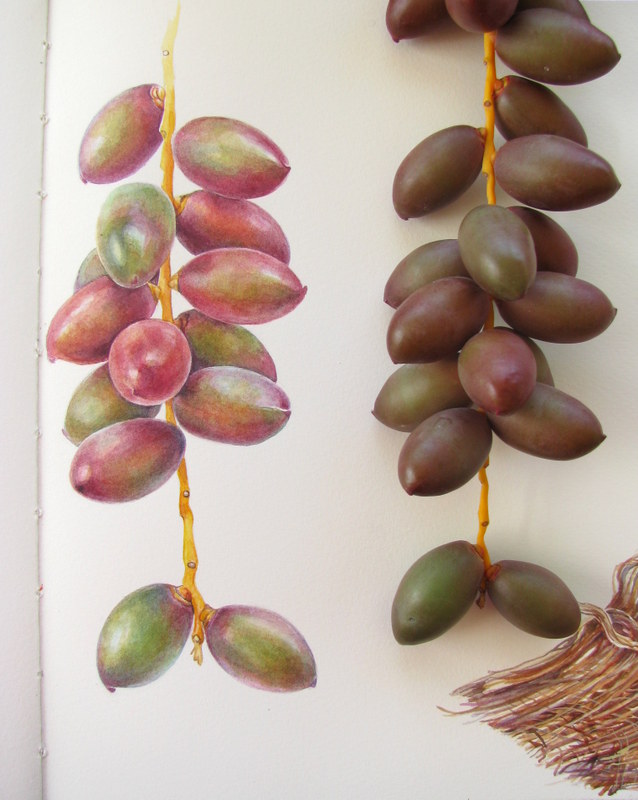
I love date palms. They are such beautiful trees, particularly when laden with fruit, and I have been inspired to paint them many times over the years. The date palm, Phoenix dactylifera was an obvious choice when it came to selecting a theme for my RHS paintings. Unfortunately they don’t grow well in Ireland, so whilst I am here in Egypt, I need to gather as much visual information as possible (colour studies, sketches and photographs), to enable me to complete the paintings when I return to Dublin.

Dates and palm leaves studies from last year
For the last couple of years, I have concentrated on painting the fruit, but for the RHS I want to show all the aspects of this tree that make it so unique. So I have been reading everything that I can about this plant and trying to decide just how to depict it.

However before I can begin, I need to sort out my colour palette! Whilst I was happy enough painting the dates last year, the leaves were a struggle. Try as I might, I just could not get the right green. Green is always a difficult colour to get right, and palm leaves are a particularly elusive blue-green shade.


One of the reasons for their unusual colour is the waxy bloom that covers both the fruit and the leaves. 

All plants have this bloom- you can see it quite clearly on fruit such as plums and grapes, but it’s very apparent on desert plants. For years people thought that this bloom was caused by wild yeast cells, but recent discoveries have shown that this bloom, or epicuticular wax, is an important part of the plant. It's main role is to prevent water loss. It also reflects UV radiation and helps deter insects by making it difficult for them to walk on or lay eggs. Amazingly if the wax is accidently rubbed off the plant, it will grow back. Finally it helps the plant to self-clean, causing water to bead up and roll off, taking particles of dirt and dust with it. I found this really informative article which is well worth reading.

Bloom is also notoriously difficult to depict in watercolours, particularly when the use of white is so frowned upon. I know that some artists paint bloom by mixing a tiny bit of cobalt with white gouache and drybrush it on afterwards, but most (myself included) carefully paint the bloom first and build up the darker colours around it. The problem is trying to find the right bloom colour!

There was just one thing to do… make a colour chart of soft greens. The right one must be in there somewhere!!

Last year I read a really great article on the ASBA website by Carolyn Payzant, a botanical artist who has spent a lot of time painting the desert plants of Arizona. To achieve those grey blue greens, she recommended Oxide of Chromium. To my delight, I found that she was right. However Oxide of Chromium is not an easy colour to use. It’s very opaque and also heavily staining, a description that will have most botanical artists backing away in horror! I think the trick to using a colour like this is first to use it sparingly, and also to only mix it with transparent or semi-transparent pigments.

Sometimes the only way to get a colour right, is to keep practicing over and over again
I played around with several mixes and found that W&N Winsor yellow and M. Grahams Cobalt blue gave the best results. The big success of the day was M. Grahams Cobalt teal. What a gorgeous colour for bloom! I found that using Cobalt teal in my first washes gave that perfect glaucous blue, especially when I allowed a wash of Cobalt to bleed into that first wash.

Experiment with different mixes and don't forget to write down the names of the pigments

Alas, I have fallen out of love with my Saunders Waterford sketchbook. I really liked the look and size of this sketchbook, and have been using this for my date studies. The deckled edges and the creamy colour are so appealing, but I just don’t like the paper. It’s far too absorbent and rough. I switched to a piece of Fabriano Artistico to paint some date seedlings and was immediately amazed at how much nicer the surface was to paint on. It was much easier to get clean crisp edges on the Fabriano. I’ll still continue to use the sketchbook, but will probably stick sheets in.

A trio of date seedlings- colour studies which I plan to use in one of my future RHS paintings

I couldn’t resist painting one little date using the same green mixes as the leaves. This date is unripe and not full size, but the ones on the trees are beginning to turn a rosy pink. No prizes for guessing what I’ll be painting next week!


"Colour is my day-long obsession, joy and torment." 
Claude Monet


Saturday, 5 July 2014

The Spice Market

   "Let food be thy medicine, and let thy medicine be food." Hippocrates

Doum, Carob, Star Anise and Senna

Sometimes you find yourself painting a subject which absolutely captivates you, and this week has been one of those weeks for me. 
Yes, I know I tend to get pretty excited over most of my subjects, but the spices from the Egyptian market have been a joy to paint. It’s not just the rich colours and the variety of textures that have me spellbound, I’ve been reading up about them too, and spices are quite simply fascinating.

Nowadays we give little thought to these aromatic seeds and dried roots, but once upon a time, the Spice Trade was the world’s greatest industry. In fact, the spice trade has shaped the world as we know it- empires were created and destroyed, great fortunes were made and let us not forget, it was the quest for a new spice route that led Christopher Columbus to discover America.


Spices come mainly from the Middle East and Asia, and for many centuries, the Arab traders dominated the market. The wonderful tale of Sinbad the Sailor was inspired by the spice trade- he was said to have been a trader of cloves and cinnamon. Spices were brought from Arabia and Asia across land by camel to Alexandria in Egypt, and from there were shipped to Europe.  

Such was the value of these spices (frankincense , myrrh, nutmeg, cinnamon, cloves and peppercorns to name but a few), that the source of these spices was kept a closely guarded secret. To deter any rivals, the Arabs told fantastical tales about the dangerous creatures that the spice traders had to encounter. 

Herodotus, a Greek historian in  5 BC wrote that cinnamon sticks were collected by huge and ferocious birds from an unknown land, and used to make their nests on sheer cliff faces. To get the cinnamon sticks, the Arabs would bring dead donkeys and oxen as bait. The birds would swoop down and seize the meat, carrying it up to their nests. However, the nests would not be able to hold the weight of the meat, and would fall to the ground, enabling the cinnamon sticks to be gathered by the waiting Arabs.

In fact, cinnamon is the inner bark of Cinnamomum iners , a fairly common shrub that grows in Arabia!


With all these wonderful tales, it’s no wonder that I have been enjoying painting these spices! 

As this painting is for the SBA exhibition “Poisonous and Medicinal Plants” in Germany, I’ve also been researching their medicinal uses.
The spices in the market are presented in large baskets, which prompted me to paint this collection in a circular format.  Although they all differ in colour, I kept the same colour palette throughout to bring harmony to the composition. The smells were divine, always a bonus.


 Doum fruit,  Hyphaene thebaica  It has been shown to significantly lower high blood pressure, lower bad cholesterol, and raise the good cholesterol. You can read about that here

Carob, Ceratonia siliqua    Known as “nature’s candy”, carob is a healthy alternative to chocolate. It helps to regulate the digestion process, while serving as a natural anti-allergic, antiseptic, and anti-bacterial agent. It also helps regulate blood glucose.

Carob, Star Anise and Senna
Star Anise Illicium verum  Traditional used in the treatment of rheumatism, star anise is also the source of one of the main ingredients of Tamiflu, used for the recent influenza outbreaks.  

Senna, Senna alexandrina  is mainly used as a laxative

Cloves and Desert Gourd
Cloves are the aromatic flower buds of Syzygium aromaticum. Clove oil is widely used in dental treatments for it’s anti-bacterial, anti-inflammatory and mildly anesthetic affects. In medieval times it was used to preserve meat.

Desert Gourd, Citrullus colocynth A powerful purgative with anti-inflammatory properties. Extracts from this plant are being used a therapy for the prevention of breast cancer cells

Kaff Maryam and Galangal

Kaff Maryam, Resurrection Plant Anastatica hierochuntica  Traditionally used for menstrual cramps and to ease childbirth. I wrote about this plant on my blog here.

Galangal Alpinia officinarum  The word "galangal" comes from the Arabic form of a Chinese word for ginger, liang-tiang. The galangal rhizomes were widely used for their stimulant and digestive effects in medieval Europe, and were said to smell of roses and taste of spice. This dried root has an important medicinal use- it contains high concentrations of the flavonol galangin, which has been shown to slow the increase and growth of breast tumor cells.


Cinnamon, dried Hibiscus , Cardamon

Hibiscus, karkade Hibiscus sabdariffa  Made from the dried flower calyces, this is usually made into a refreshing tea which is proven to reduce blood pressure 

Cardamon Elettaria    Has antiseptic, antispasmodic, carminative, digestive, diuretic, expectorant, stimulant and tonic qualities, and is also a rich source of vitamins and minerals

Cinnamon Cinnamomum iners  has powerful anti-viral properties and has been used in the treatment of diabetes. However it has also recently been shown to inhibit the development of Alzheimer’s disease in mice

Nutmeg Myristica fragrans   has anti-fungal, anti-depressant, aphrodisiac, digestive, and carminative functions. It is also a good source of minerals like copper, potassium, calcium, manganese, iron, zinc and magnesium, as well as being rich in vitamins B and C and folic acid.

The Spice Market,  ©Shevaun Doherty 2014

"All that man needs for health and healing has been provided by God in nature, 
the challenge of science is to find it." Theophrastus

Friday, 27 June 2014

The Fruits of Doum

Marianne North's Doum and Date palms on the Nile above Phillae
I’m very excited about the SBA’s exhibition, “Medicinal and Poisonous Plants”, in Frankfurt this October. The theme is one that really appeals to me, and has given me the perfect excuse to paint and research some medicinal plants that I have been wanting to paint for ages.

Egypt has long been famous for it’s herbs and spices, and in every Souk (market), you can find a spice shop- a wonderful Aladdin’s cave of spices, medicinal herbs, aromatic incenses, fragrant essential oils, all stored in large colourful baskets. Buying your wares involves a fair amount of haggling and friendly banter, along with the obligatory cup or two of fresh mint tea. I left with a bag full of exotic treasures.


First onto the drawing board is the very peculiar fruit of the Doum palm, Hyphaene thebaica, also known as the gingerbread tree. The tree is not as common as it once was, in fact, I have only seen in growing in the south of Egypt, but in ancient Egypt, every Egyptian of standing would have had these trees growing in his garden. 

Doum tree painting on the tomb walls of Sennedjem http://www.osirisnet.net/tombes/artisans/sennedjem1/e_sennedjem1_01.htm

The Doum Palm was considered a sacred tree, and symbolised of male strength and virility.   In fact, the fruit of this tree was of such importance that eight baskets full of dried doum fruit were discovered in Tutankhamum’s tomb, left to provide him with sustenance in the afterlife.


I am also painting the dried fruit. It’s rock hard with a shiny sienna-coloured appearance, and even though it’s dry, it smells delicious. Pliny describes it in his Natural History Book-

“... the wood of the cucus is held in very high esteem. It is similar in nature to the palm, as its leaves are similarly used for the purposes of texture: it differs from it, however, in spreading out its arms in large branches. The fruit, which is of a size large enough to fill the hand, is of a tawny colour, and recommends itself by its juice, which is a mixture of sweet and rough. The seed in the inside is large and of remarkable hardness, and turners use it for making curtain rings. The kernel is sweet, while fresh; but when dried it becomes hard to a most remarkable degree, so much so, that it can only be eaten after being soaked in water for several days. The wood is beautifully mottled with circling veins, for which reason it is particularly esteemed among the Persians.”

I never knew that the ancient Egyptians used curtain rings!

I paint little squares of all the possible pigments first, to help me select the right colours

Despite being dry and hard, you can eat it. The only way that I can describe it is like biting into MDF to find it dissolving in your mouth and tasting a bit like the honeycomb centre of Maltesers. I haven’t tried soaking it. It’s usually made into a very sweet drink. The ancient Egyptians were correct to appreciate it’s health-giving properties- studies conducted by Egypt's Mansoura University found that it significantly lowered high blood pressure and great reduced the risk of cardiovascular disease. In fact, it’s an all-round “super-fruit” packed with many nutritious and medicinal properties.


It is extremely hard and took me a long time to scrape the doum nut clean for the dissection. The “nut” is also rock hard, and has been described as “vegetable ivory”. Apparently there once was a factory set up over here to make buttons from it, in the days before plastic took over the world.


Building up the layers of colour slowly (not finished)
Painting here has proved a bit of a challenge, mainly because it’s so dry and hot. This year I brought a small bottle of ox gall with me, and although it doesn’t extend the drying time of the paint, it certainly helps improve the spreading of the washes. In between layers of paint, I’m having to pull a damp brush over the whole surface just to soften the edges of the paint. My new Rosemary flats are perfect for this.


I painted a few practice doum fruit, and then tried out a Carob seed pod, Ceratonia siliqua. I’ve often seen these pods but was put off by the rather pungent smell. However having read about all the amazing health benefits, and the fact that it’s being used more and more as an alternative to chocolate, I decided to try some. It’s delicious. The pods are quite edible dry and nicely chewy, but it’s more usually made into a really refreshing drink. Again, it’s one of those "super-foods", having analgesic, anti-allergic, antibacterial, antioxidant, antiviral and antiseptic properties. The seeds are interesting too. A resinous gum can be extracted from them which, in ancient Egyptian times was used to bind mummies. Nowadays this extract is used as a thickening agent, emulsifier and stabilizer in beverages, candy, desserts, ice cream, salad dressings, cheeses, jelly, baked goods and other products. The seeds were also used as a measurement of gold during Roman times … twenty four seeds being equal to the weight of one gold coin, which eventually gave us the phrase “24 carat”.


I added a few more practice pieces to my study page- karkade (the dried calyces of hibiscus flowers Hibiscus sabdariffa ) which are used to make a refreshing drink)

Carob seeds, Cardamom pods (Elettaria cardamomum) and  Star Anise (Illicium verum

Senna pods (Senna alexandrina) and dried Desert-gourd (Citrullus colocynthis


I’m going to enjoy painting this piece- the colours, the textures and the smells. My practice page is almost done, now it's time to start on the real thing.

"Each morning sees some task begun, each evening sees it close 
Something attempted, something done, has earned a night's repose."


Friday, 20 June 2014

Flaming Hot


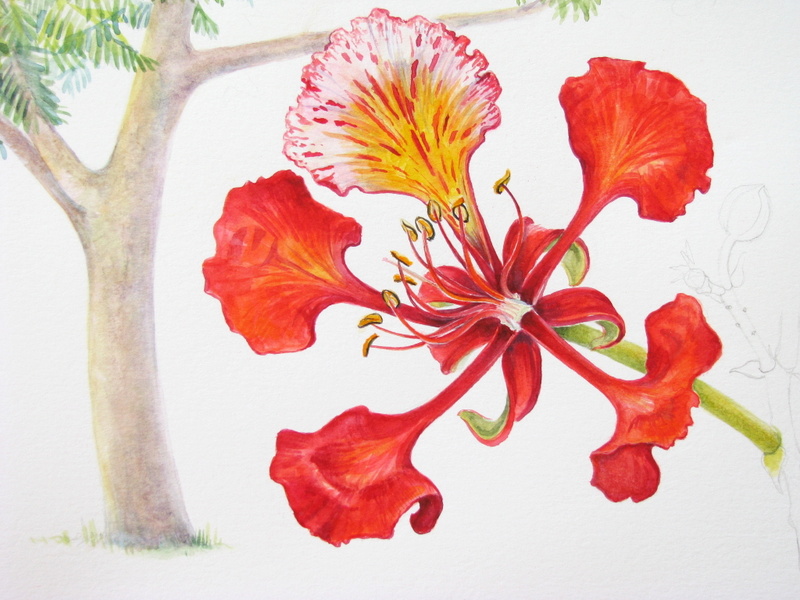
The Flamboyant Tree, Delonix regia     ©Shevaun Doherty 2013
They say that once you have drunk the waters of the Nile, you are destined to return.

There must be some truth in that, because for twenty five years I have been coming back to this beautiful country. It really is wonderful to be here once more, back to the palm trees and shimmering heat, and my lovely home by the sea. It took a few days to unpack, settle in, and  recover from the long trip. I am delighted to say that my paints, brushes and large tube of paper all arrived safely too.

My studio overlooks the gardens and the pool, and you can just glimpse the turquoise sparkle of the sea through the palm trees … it’s not surprising that I love it so much!
 My only grumble was that the air conditioning in my studio wasn’t working. It’s fine in the morning, but by early afternoon the sun has crept around to that side of the house and with temperatures of 41°C, it makes painting a challenge! Somehow I don't think I'm going to get that much sympathy!!

Yes it is!!
Bird's eye chili peppers Capsicum annuum 2014


The dates are still not quite ripe. They hang in clusters, small, green and hard, and tantalisingly just out of reach. They need a few more weeks of sun to ripen. However, there’s plenty to keep me inspired and busy whilst I wait. I decided to do a small study of one of my favourite trees, Delonix regia, also known as the Flamboyant Tree or  Royal Poinciana

It is considered one of the most beautiful trees in the world, and you only have to see it in bloom to realise why. It is covered in an exuberant mass of fiery red blossoms. Quite simply, it’s a stunner! 

Sketchbook studies 2010- I didn't have a lot of reds in my art box then!!
I have painted this tree, or rather, I’ve attempted to paint it many times. One day I will do a painting that does it’s beauty justice. The flowers themselves aren’t too difficult, but the lacy fern like leaves with their multitude of tiny leaflets are not for the faint-hearted! It also has pretty impressive seedpods of up to 50cm in length! I was grateful to be able to look up my earlier studies to see what colours I used- it makes life so much easier when you take note of your colour palette!

Sketchbook studies 2012... better paper, a bigger selection of reds but a poor photograph (sorry)
Sketchbook study 2014
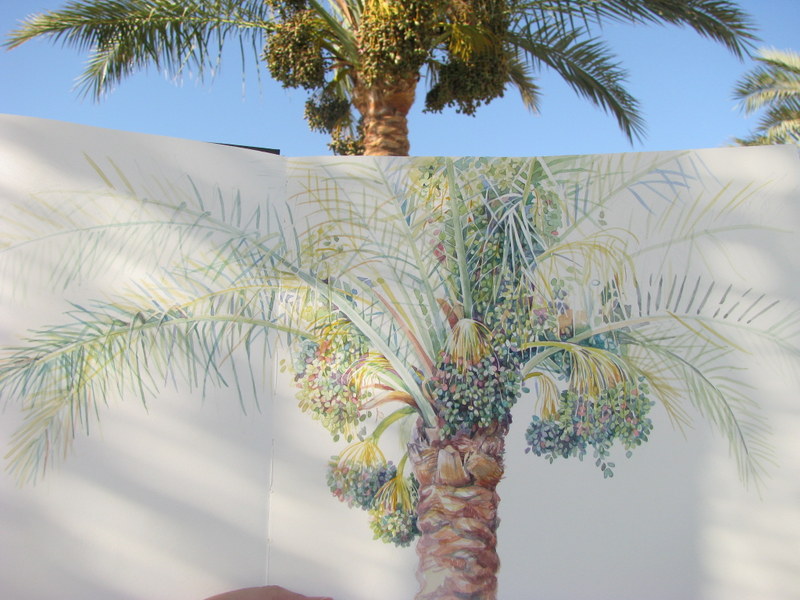
As this was just a sketchbook study, I decided to experiment and include a plein air study of the tree as well. Okay, I confess! The fact that there happens a tree growing right beside the pool where I have a comfortable sun lounger and an umbrella did play a part in this decision. It was great to loosen up and splash the paint about a bit, and I also had a bit of a splash in the pool to cool off when I had finished! 
This little piece will be stuck into a sketchbook upon my return for the Nature Trails sketchbook exchange.

A little plein air piece finishes it off nicely. The colours used were Winsor lemon, Winsor yellow, Winsor yellow deep, Winsor orange, Winsor red, Vermillon (Sennelier), Dark red (Schminke), Pink Madder (Pebeo), Alizarin, Quin red, Quin violet, Cerulean, Indanthrene and Perylene green.

So onto the next painting whilst I wait for these dates to ripen! The SBA are holding an exhibition in Palmengarten in Frankfurt in October, Poisonous and Medicinal Plants. I love this theme. I’ve already started a few studies in preparation. I won’t say much more, except that it involves a trip to the Spice Shop in the local Souk. Thankfully the air conditioning is now fixed… I’ve no excuse!


Plein air sketch of the local spice shop, 2009
I hope you are all enjoying your summer!

 “We live in a wonderful world that is full of beauty, charm and adventure. There is no end to the adventures we can have if only we seek them with our eyes open.”


Friday, 6 June 2014

Preparing for the Next Adventure

“ Here’s to freedom, cheers to art. 
Here’s to having an excellent adventure and may the stopping never start.” 
 ~Jason Mraz

May really has been exhilarating and fun, but tiring too. 
The paintings have all been taken down- some heading to new homes, others heading to Claregalway Castle, and the ISBA’s Aibitir exhibition is heading to Derry and Belfast.
I’m also packing up and preparing to travel. 

I'm dreaming of warmer weather and painting outside
School has finally ended and for me that means only one thing … Egypt. This year I’m going back with added purpose, because I will finally start on my next project, my RHS paintings.

Last year I applied to the RHS and to my amazement, I received a letter saying that my work is suitable for an RHS exhibition! I now have five years to complete a set of paintings on a theme of my choice, and I know exactly what I would like to paint! It has to be the date palm, Phoenix dactylifera. Our garden in Egypt is full of them, and I just love painting them.

Sketchbook studies
Ripening dates

However I need to plan this out very carefully. I need a minimum of six paintings for the RHS and these paintings must work as a coherent exhibit. So my first consideration has been what paper to use, and what size the paintings should be.
I have been really fortunate to have met some amazing artists in recent months and have asked them all about their paper choices. Katherine Tyrrell was a great help- not only has she written a great series of articles on RHS winners, but she also took the time to go around the SBA exhibition with me and talk to me about size.
It appears that size DOES matter after all.

Struggling to make it fit on an A3 paper. 

Gael Sellwood was also a great source of information- she recently won a gold medal and also Best at Show at the RHS in Malvern. After our conversation, I decided that I would ditch the Fabriano Classico which I had been using since my SBA student days, and go for the better quality Fabriano Artistico.
My good friend Dianne Sutherland wrote an excellent blog post on all the papers. An RHS medallist herself, she too favours the Fabriano Artistico. Finally Sarah Morrish wrote a great piece comparing all the papers , and even gave me a few samples to try out at home.

So this week I took the plunge and  bought what seems an absolutely enormous roll of Fabriano Artistico 300gsm paper. By chance I found that the cheapest place to buy the paper was on my own doorstep at K&M Evans in Dublin. They were significantly cheaper in price than the UK companies.

My enormous roll of Fabriano Artistico dwarfs the A3 Fabriano Classico that I've been using. Below is the  tube which at 75cm wide. just fits into my suitcase.
Oh the thrill of all that paper! It’s a massive 140cm wide and 10 metres long, which, when you consider that I’ve been working on paper that’s 29.7x42cm (A3), seems quite daunting. I have been struggling with this restrictive size, so it will be a welcome relief to be able to work on a bigger area! The nice folks at K&M Evans also gave me a tube for travelling. I will have to cut some of the paper down to 75cm in order to fit, but at least the paper will be survive the numerous plane journeys ahead!

Completed study page 2013
I’ve also been making the slow switch-over to buying pans instead of tubes of watercolours. I had never really given the whole pans vs tubes debate much thought before, but read a fascinating post by Janene Walkky about the difference. What a revelation! 
Having pans of paint also meant that I am less likely to run into problems when travelling. I hate having to put my paints into my suitcase and into the hold of the plane. I can survive without clean clothes or even toiletries, but if my suitcase was lost with my paints inside, I would be a very grumpy artist indeed!

Date tree study, laden down with fruit 2013
It was also time to think about brushes. I really love my Winsor & Newton series 7 sable miniatures, but it seems that recently everyone has been raving about the Rosemary& Co brushes. I put in an order for some spotters and some ‘cat’s tongue’ filberts and was delighted to find that not only are they a better price, but they were delivered incredibly promptly too. 

New brushes!
So that’s it. I’m all set for the long journey ahead and hopefully a very pleasant summer of painting. I’ll need a week or so to get myself settled and the internet sorted, so there’ll be a short break in the blog posts until then.

I’m ready for a new adventure!

"There is joy in feeling the bristles of a quality brush, seeing the richness and lush color of truly good pigment flowing onto the paper or canvas. The cheap stuff just makes for harder work and lesser results."
 ~Gene Black